We were somewhere around Seattle in the mid-1980s when the music began to take hold.
Not the cheap corporate jingles or the polished arena rock they were force-feeding the masses. No. This was different. This was Bob Marley the man, the music, the movement crashing into my life like a freight train full of ganja smoke and righteous prophecy. And it all started with a guy who kept changing his name until the right one stuck: Scott Critten, who became Scott Haynes, who became Skeeter Snake Bite Dunbar, and finally just Snake Bite. And finally my brother in law.
The same wild bastard who also dropped Hunter S. Thompson on me like a lit cherry bomb in a toilet bowl.
Two life-changing figures in one hit. Hunter brought the chaos and the chemical-fueled truth-telling. Bob brought the peace that somehow felt more dangerous than the chaos.
I was 22, pulling night auditor shifts in a burgundy sport coat, smiling at guests and welcoming them to Seattle while secretly plotting how to become the next General Manager at Hyatt without selling my soul to the corporate devil. My superiors kept trying to drag me into the political game — city council whispers, hospitality lobbyist promises, the whole ladder-climbing scam. I’d smile and say, “Sorry, I’m Canadian. Can’t hold office here.” Quiet lies of a forbidden corporate sell out in time.
Technically true enough for a dual citizen, but mostly a convenient lie. I’d seen what that road did to my friend Jeff. I wasn’t about to become another suit who traded his spine for a corner office and a fat expense account. My identity at the time was simple: night auditor, hospitality student, and the next Bob Marley.
That last part didn’t last long.
The Ritual
Snake Bite or “Skeeter be de gay,” as we’d say it in our thickest Jamaican accents was the high priest of the daily ceremony. The man was meticulous as hell. Every afternoon he’d pre-roll a fresh supply of bong hits and lay them out on the table like offerings. When the rest of us stumbled home from work, the bongs were cleaned, the water was chilling in the fridge with fresh ice ready to go, and Bob was already queued up loud enough to rattle the windows.
The routine never varied:
Drive home. Grab a pizza. Change out of the work uniform. Hit play.
Then we’d melt.
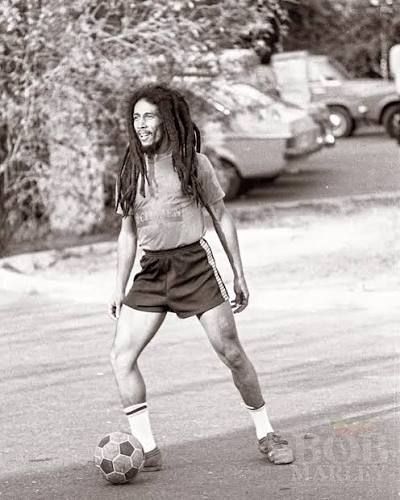
Rainer beer. Snake bite shots. The sweet, thick smoke filling the room. F1 on the TV one night, motocross the next, hockey when the season was right. And hacky sack that beautiful, pointless little game that somehow felt profound because we’d seen footage of Bob Marley himself playing soccer like a man possessed by joy. We wanted to move like that. We wanted to live like that.
My crew was tight: Ed, Scott, Jeff, and Steve. Four guys who smoked, drank, laughed, and argued about everything while Bob’s voice wrapped around us like a warm blanket made of bass and revolution.
The Obsession
At first it was the music. Then it was the man. Then it came the whole Rastafarian thing — the rejection of Babylon, the love for humanity, the peaceful warrior stance that felt like the exact opposite of the political bullshit my job kept trying to pull me into. I got engrossed. I justified the daily ganja as spiritual practice. I would’ve grown the dreads if the hotel had let me.
For three glorious, hazy months I was all in.
Then two things happened at once.
I realized the full Rastafarian lifestyle wasn’t exactly compatible with my long-term plan of running a Hyatt someday. And I found out Bob was already dead. Had been since 1981.
That changed the equation.
The music didn’t die. The message didn’t die. The way he treated people — that stayed with me. But the religion? The “populate the earth through love and peace” philosophy that apparently involved Bob fathering something like 500 children with multiple lady friends? That was the exit ramp.
I hitched my wagon to Ziggy Marley, son of Cedella — Bob’s true wife in the eyes of many — instead of trying to live the full multi-partner, multi-child Rasta blueprint. I was no saint at the time. I had my share of sleepovers and wasn’t exactly loyal to anyone. But spawning an entire village of children across multiple partners? That wasn’t me. I defaulted back to Catholic, which at least made my parents happy.
In the end I settled on a simpler truth: Bob was a rich, talented, complicated musician who banged a bunch of women, had a bunch of kids, and died too young. But his music? His music knew exactly who I was at 22 — a kid in a burgundy jacket looking for something realer than the corporate ladder and more peaceful than the political snake pit.
The Why That Still Lingers
Even after we all grew up and mostly pulled away from the heavy daily smoking, Bob stayed. I decided to walk away from the drinking, smoking and get my life more focused on my Hyatt Career, it was a turning point. I never looked back, either did my five friends.
The music became the soundtrack to our friendship the five of us, older now, scattered but still connected by those nights when the bong water was cold, the pizza was hot, and everything felt like it was going to be alright.
I still catch myself smiling when three little birds land on the doorstep or the fence or the power line outside. Still feel that same warm, defiant peace when the right Marley track comes on. Still grateful that a man named Snake Bite (my brother in law Scott) with his pre-rolled offerings and his heavy Jamaican accent kicked open the door to both Hunter’s madness and Bob’s light in the same wild season.
One gave me the courage to see the machine for what it was.
The other gave me the soundtrack to walk away from it without losing my soul.
Everything’s gonna be alright, man.
Still is.


Leave a Reply